AI makes your expertise more valuable, not less

May 19, 2026
The reliability question keeping leaders up at night is not really about AI. It is about whether your company's expertise is reachable enough to make AI trustworthy at scale.
The demos are impressive. The LinkedIn examples are impressive. Someone's clever workflow that turned a three-day job into twenty minutes, re-ally impressive.
And then you sit down to transform team work and actually use AI where it matters in your organization. Now being wrong has a cost, hallucinations are really painful and the question becomes a different one. How do you know the output is right? How do you trust it enough to publish it, put in front of a client, the board or a regulator? How do you stop AI from narrowing you to a clean-looking answer that misses what the situation actually needs?
The answer lies in:
1) picking the more agentic models,
2) optimal and consistent prompting across the team (aka: SKILLS)
3) bottling and unlocking your working IP, your company’s knowledge and
4) making sure instructions and reviews are done by the absolute experts.
People worry about AI taking over. But given the 3rd and 4th point, real expertise has just become more valuable, not less. The expert's value goes up with it. Their judgment is now touching way more parts in the company.
The "human in the loop" misconception
There is a phrase you hear a lot in AI conversations: "human in the loop." Someone reviewing AI output before it gets published or accepted.
Here is what nobody says out loud. A human in the loop is often rather useless if the human is not a subject matter expert. They cannot check the output. They do not know half of what to look for. They are approving something they could not do themselves, and building on whatever the AI got wrong.
When an expert checks AI output, they see it instantly. They know which five things to change, which two structural pieces to redo, to make it 100% spot on. Plus they prompted it well in the first place. They have done this work for years and have more context than we fed the AI. They know what good looks like, where the trap doors are, what the AI just confidently got wrong, and why it matters in this specific situation.
That is not "human in the loop." That is expert in the loop. Different concept. Different outcome.
Where AI quietly leads you astray
The reliability problem is not only about errors in the output itself; the famous hallucinations or just vague phrasing to cover for ambiguity. It is about the shape of the answer itself.
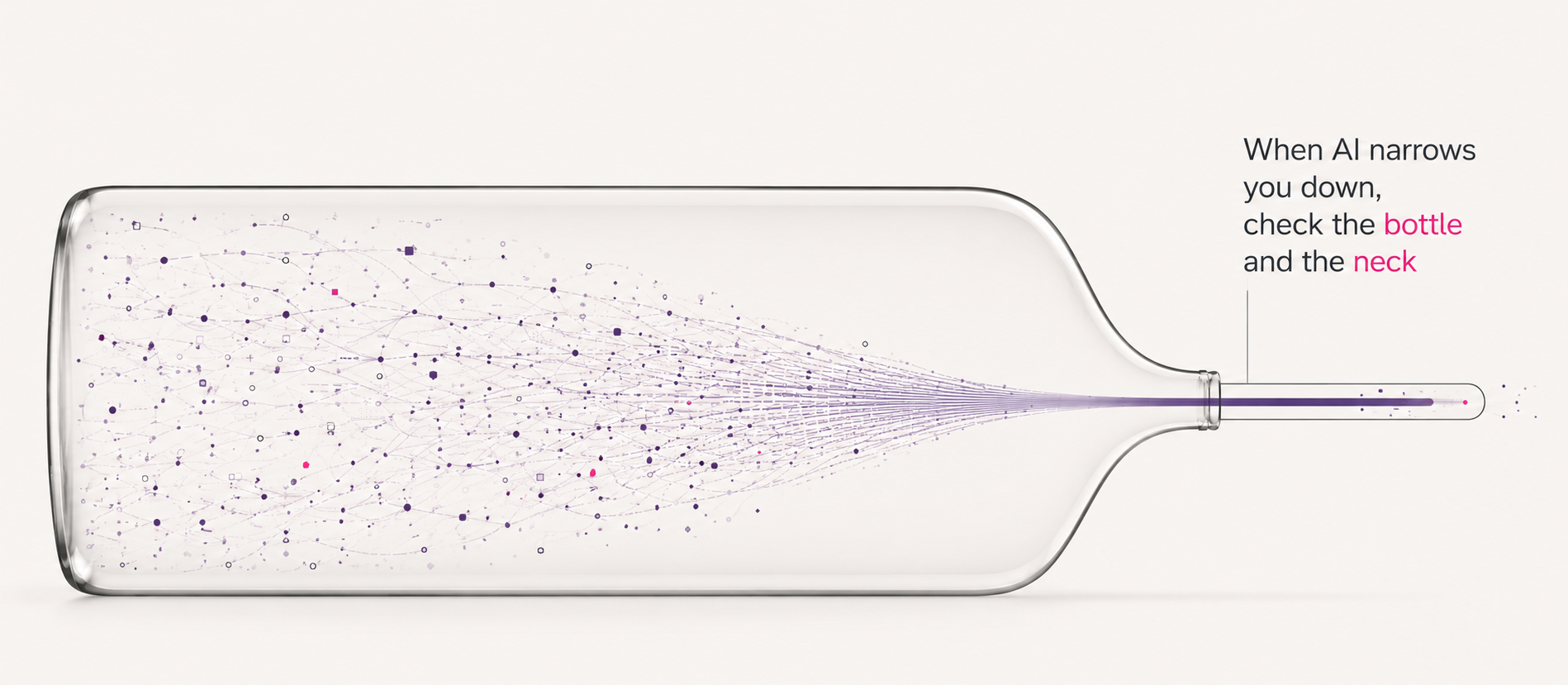
AI narrows you. You ask a specific question, you get a specific answer, you move forward on that line. The output looks complete. It doesn’t tells you what it left out, what frame it adopted, what the better question would have been. Going from narrow back to broad is a real cognitive move that AI does not naturally support.
This is where the expert wins again. They know when the answer in front of them is too clean, too neat, too narrow for the situation. They know what the question should have been. And what has been left out.
They widen the lens on instinct, because they know what else is in the room. A non-expert takes the narrow answer and runs with it. An expert takes the narrow answer, recognizes what is missing, and goes back at it from a different angle. Same tool, completely different result.
Without expert background, and especially without really well and detailed context input, AI output is not safe ground for high-stakes decisions. With expertise, it is amplified ground.
So what actually changes
The reframe is simple. Don’t ask if AI is reliable enough to use. But ask whether your expertise is reachable enough for AI to make it reliable.
Most AI setups skip that question entirely. They install the tool, the LLM platform and write some prompts, and hope. The AI then produces whatever it can piece together from public and available information data and whatever people paste in. The output looks professional. It is not yours. It is often not even right. And the only person who can tell the difference is the expert.
This is where there is work in front of us. Not in prompting tricks. Not in better models. In making what your best people know available to the best AI models in the first place. The judgment they exercise without thinking about it. The reason certain answers are correct in your context and wrong in someone else's. The "it depends on which client, which market, which moment" that nuanced context lives in heads and we haven’t been able to bottle it.
When that knowledge is encoded, and made available, the AI stops guessing. The expert stops being the bottleneck on every output and becomes the architect of the system. The output quality goes up significantly.
POV
If you are one of the people in your company who can see where AI gets it wrong, that is THE reason to lean in and architect the system and bottle your company's knowledge well.
P.S. If you are setting up AI for your company, the first question is: what does your AI need to know about you before it can be trusted to speak for you?
%20(2).jpg)
.png)