How to make your reputation travel

October 20, 2026
AI agents now help build every shortlist. They reward consistency, clarity and what others say about you. Here is how to make your reputation travel.
What is your brand worth to an agent?
Making or missing a shortlist has never been this close. A CEO asks a junior for a shortlist in your space, and it won’t take that person and their LLM more than 15 minutes to deliver it. The less they know, the more generic the question will be. The more they know about what really matters for the match, the more likely they are to find you.
Losing a deal after a long RFI, RFP and pitch trajectory is a real setback. It can be painful, and sometimes it even feels personal. Not being on the ‘talk to’ list is worse, but painless and invisible.
The best new business comes through referrals. That is the case for me and for all of my B2B tech clients. When you are in the business of being at the heart of your client’s business, it means a ton when people know you personally, trust you as best in the biz, know you go all in for them, and know you are decent people.
That is your reputation. It lives in the heads of great people who were in the trenches with you before. ‘You’, not just your company. This is still a very personal play. Agents will play a growing role in selection and procurement, but people still trust people, and agents build on that human trust as input.
Trust is the currency of companies, and building it has always been the job of PR and brand. The game is knowing what you are known and trusted for, and getting the people who underwrite that to talk about it. They will do so not because it makes you look good, but because it is a gift to their own reputation and position.
But that is the catch. Your fame sits with them. They will call you for the next gig, but their network has never heard of you. They don’t automatically bring you up at drinks or dinners. Reputation does not travel on its own. So how do you make it travel, and how does that even work when agents do half the judging?
Reputation carriers
Reputation always needed carriers: clients who referred you, journalists who wrote about you, analysts who put you in a report or quadrant, former colleagues who recommended you in the right room.
Every carrier keeps a different score. The press rewards news. Search rewards keyword relevance and links. Social rewards frequency, interaction and personality. Every time the carrier changed, the companies that understood it early pulled ahead, and the rest caught up late and expensively. And the scores do not transfer: a good Google ranking does not predict whether an agent cites you.
Human carriers have a big advantage: they are generous. They fill gaps. They remember how you made them feel and how you made them shine, they forgive a weak page on your website, and they retell your story in their own words.
Agents as reputation carriers are less generous, yet they keep long-term score, and they remember without searching. More importantly: they come between you and humans. The CEO’s junior uses one. So do analysts and journalists, who now research with agents too. And analysts and agents share a taste: they prefer the long form, and being correct over being snappy.
What a brand means today
“A brand is what they say about you when you’re not in the room.” That still holds. For humans, the visual identity is the mental container that keeps it all together.
To a human, a brand is a shortcut to trust, or not. To an agent, a brand is a prior: the first assumption it makes about you before it weighs the details. A strong prior gets you recommended. A weak one turns you into a spec list, and spec lists compete on price. That is what your brand is worth to an agent: the difference between being named and being compared on price.
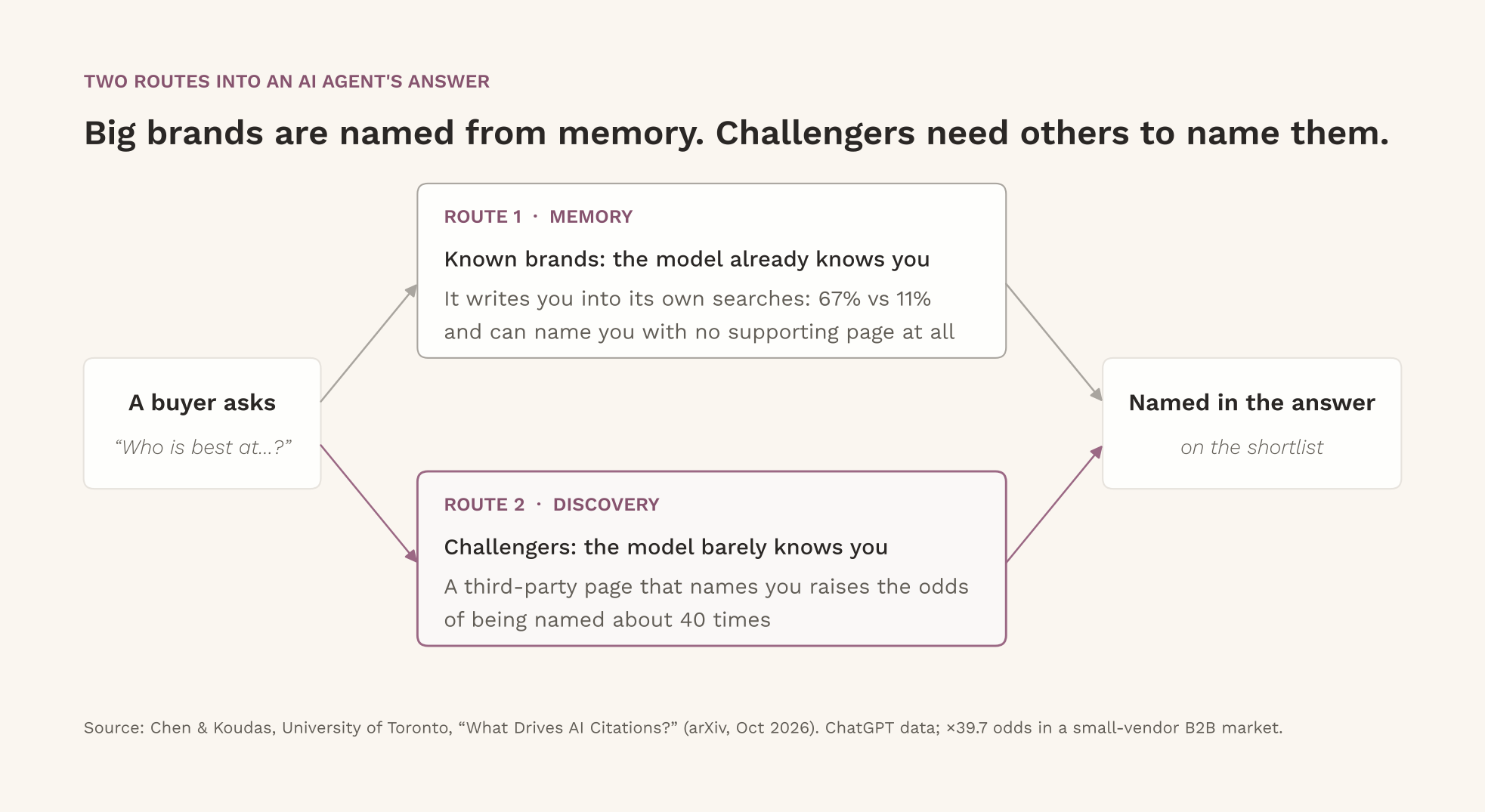
Researchers at the University of Toronto showed how literal this is. They gave a model the same product facts under different brand names. The same profile made the top three in 80% of answers under one name, and in 39% under another. Their summary: “Pages are cited when searched; brands are named when remembered.”
Interestingly, agents judge brands just like humans do, only more strictly. Big brands live in the model’s memory, and challengers get in when others write about them. For lesser-known vendors, a third-party page that names them raised the odds of being named about forty times. A form of discovery for the LLMs.
The main things, more now than ever
Consistency. The agent reads everything at once: your homepage, your CEO’s posts, a press release from 2021, your job ads, a partner page, a forum thread. Before, an inconsistency stayed hidden because each audience only saw its own part. Now it shows, and it costs trust. CMOs, here is your argument in the debate about the employer brand: it does not sit with HR, and it is not something separate. The good news: it has never been easier to watch and steer.
Clarity. Agents compress. They turn a hundred pages about you into three or five sentences. If your position is vague, it disappears in that compression. None of this is new. It was Steve Jobs’ point exactly: presenting a company by what it can do does not build a mental picture of it. The brand is what keeps the story standing when the machine summarizes it.
What others say. Agents trust third parties more than they trust you. Partners, clients, analysts and the press carry more weight than your own claims. They always did; it was just never said this loudly. So give others something to talk about, and take PR seriously again. News matters, and news is a wide area.
For agents to recognize your brand, being specific, uber-consistent and standing out (contrarian) works best. And tell me when that wasn’t so?
Who does the agent think is the expert?
An agent builds its frame of “who is the expert” from a few signals: the same claim, held over time, found across many sources, and confirmed by others. That changes two things marketers do every day.
Thought leadership. Opinions get likes. They do not travel to agents, because they are not specific enough to cite. Owned ideas do: a named framework, a coined term, an essay people pass on. Name and frame your ideas and opinions into something that stands out, something contrarian that others talk about, and they travel easily. Keyword stuffing does not help anymore, as it did in the SEO days. Facts, quotes and statistics do: in tests, they raised visibility in AI answers by up to 40%.
The middle of the funnel. The research phase now happens inside the agent conversation. Comparisons, proof, case detail and long-form explanation are the content agents use. You are judged more than ever, before you even know the audience exists. Answering people’s real questions, in their own words, has an entirely new audience, and your share of answer grows visibility and trust. Clarity in the buyer’s own terms beats technical tricks. Personally, I am so for this. I have seen good material ruined by the keyword crew more than once.
You don’t own your brand, but you sure can influence it
You cannot control what people or agents say about you when you’re not in the room. You never could, but you could pretend: a campaign, a message house, a tight press list. Agents end that illusion. They pick up whatever they find, from wherever it is. They easily go around you too.
Reputation and brand now work the same way as modular technology: do not lock everything into one closed suite; build it so the parts connect. The brands that win are not the loudest ones. They are the ones whose story connects across every carrier.
So, how do you make your reputation travel? Tell one clear story, everywhere, in different ways, including the employer brand. Give your carriers something specific, interesting and true to carry: news, named ideas, proof they can find. Answer your buyers’ real questions in their words, in the long form. And keep it alive, because what agents find changes all the time.
How to steer and keep course
All of this depends on a few choices that are agreed on and stored well: the brand, themes, topics, standpoints and contrarian points. What do we stand for? What is our proof? What do we refuse to say? Which stories are we comfortable sharing? If you cannot answer that clearly, no agent will answer it for you.
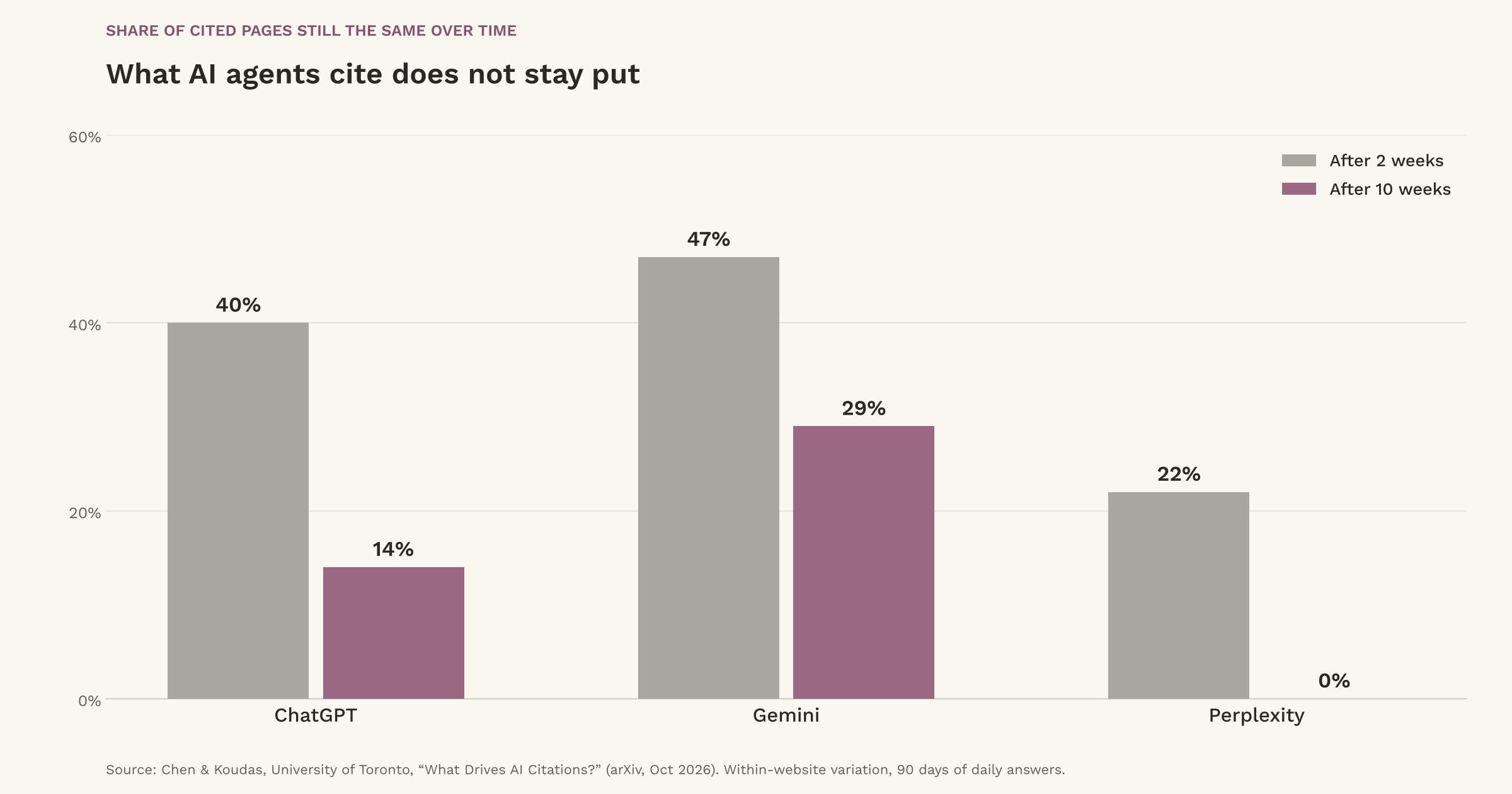
And it does not stand still. In the same Toronto study, only 14% of what ChatGPT cited was still the same ten weeks later. SEO results were far more static and predictable. Here, every question is rewritten and searched again each time.
The popular answer is a file: write a “me.md”, feed it to your AI, done. I wish it were that simple. A company’s real context is scattered across decks, docs, transcripts, posts, proposals, analyst briefings and the heads of busy leaders, and it changes daily. That is a lot of scattered stuff, aka ‘context’, and it won’t fit a me.md.
Anthropic’s engineers describe context as a finite resource that must be curated again at every step, drawn from a “constantly evolving universe of possible information”. Agents keep notes outside their context window and pull them back when needed. A company needs the same: a living, systemized memory, a system of record for its brand and messaging. Funnily, that is the one system of record companies never had, and AI begs for it. It does not just make us faster. It keeps us honest, and it flags when a conversation is needed because the story and the facts drift apart.
That 15-minute shortlist is built from what already travelled. The brands on it did the work long before anyone asked. How to build that memory is context engineering, and it is a communications discipline as much as a technical one. More on that next time.